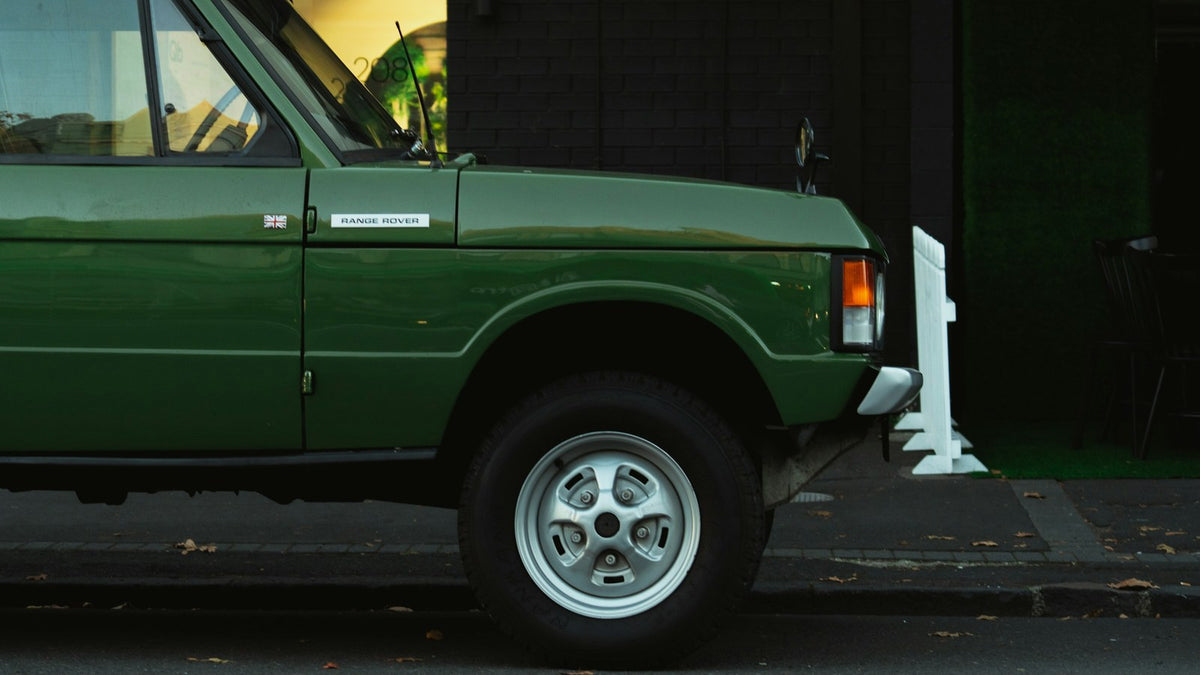
History
The Range Rover was launched in June 1970 and changed the idea of the off-roader forever. Spen King and Gordon Bashford brought together what nobody had combined before: a ladder chassis, long-travel coil-sprung beam axles, permanent four-wheel drive and the 3.5-litre aluminium V8. It was as at home on a track as on a motorway, and its design was even exhibited at the Louvre as an example of industrial design.
The first cars were simple, three-door, with interiors you could hose out. Over the years the car moved upmarket: five doors arrived in 1981, followed by the automatic gearbox, fuel injection, the Vogue trims and, in the nineties, the long-wheelbase LSE with air suspension.
From the mid-eighties it also had diesel engines, first the Italian VM units and later the 200Tdi and 300Tdi. When the new Range Rover (P38) arrived in 1994, the original was renamed “Classic” and stayed in production until 1996.
Twenty-six years of production means a lot of variants. That is why every product page shows engine, years and, where it exists, the chassis-number cut-off.
Specifications
| Production | 1970 – 1996 |
|---|---|
| Body styles | 3-door, 5-door (from 1981) and long-wheelbase LSE (from 1992) |
| Petrol | 3.5 V8 carburettor · 3.5 V8 fuel injection · 3.9 V8 · 4.2 V8 (LSE) |
| Diesel | VM 2.4 and 2.5 turbo · 200Tdi · 300Tdi |
| Manual gearbox | LT95 four-speed with integral transfer box; later LT77 five-speed and R380 from 1994 |
| Automatic gearbox | Chrysler three-speed, later ZF 4HP22 four-speed |
| Transfer box | LT230 or Borg-Warner with viscous coupling, depending on version |
| Suspension | Coil-sprung beam axles; air suspension (EAS) on the LSE and the last high-spec models |
| Brakes | Discs all round; ABS from the late eighties onwards |
Year by year
- 1970Launch: three-door, carburettor 3.5 V8 and LT95 four-speed gearbox with integral transfer box.
- 1981The five-door body arrives.
- 1983LT77 five-speed manual gearbox.
- 1985ZF four-speed automatic and fuel injection on the V8.
- 1986First diesel: the VM 2.4 turbo.
- 19893.9 V8, Borg-Warner transfer box with viscous coupling, and ABS.
- 1992200Tdi, and the long-wheelbase LSE with 4.2 V8 and air suspension.
- 1994300Tdi, R380 gearbox and styling updates. With the arrival of the P38 it becomes the Range Rover Classic.
- 1996End of production.
What we see in the workshop
- CorrosionFloors, sills, door bottoms, lower tailgate and rear chassis crossmember. The outer panels are aluminium, but the inner frame is steel, and that is what needs watching.
- Air suspensionOn the LSE and later models, the air springs, compressor and solenoid valves cause almost every fault. They can be renewed or converted to conventional coil springs. Air suspension parts
- V8 coolingRadiator, water pump and viscous fan: a V8 that has overheated is a head-gasket candidate. Keeping the cooling system in good order pays off. V8 water pumps
- DrivelinePlay in UJs, flexible couplings and flanges, and noise from the transfer box. These are simple parts to change and they transform the feel at the wheel.
- Bushes and steeringArm and Panhard rod bushes, steering joints and steering damper: with them renewed, the Classic regains the precision it once had. Bush kits